Animal Brain, Human Brain: Why Most of Us Never Complete the Journey
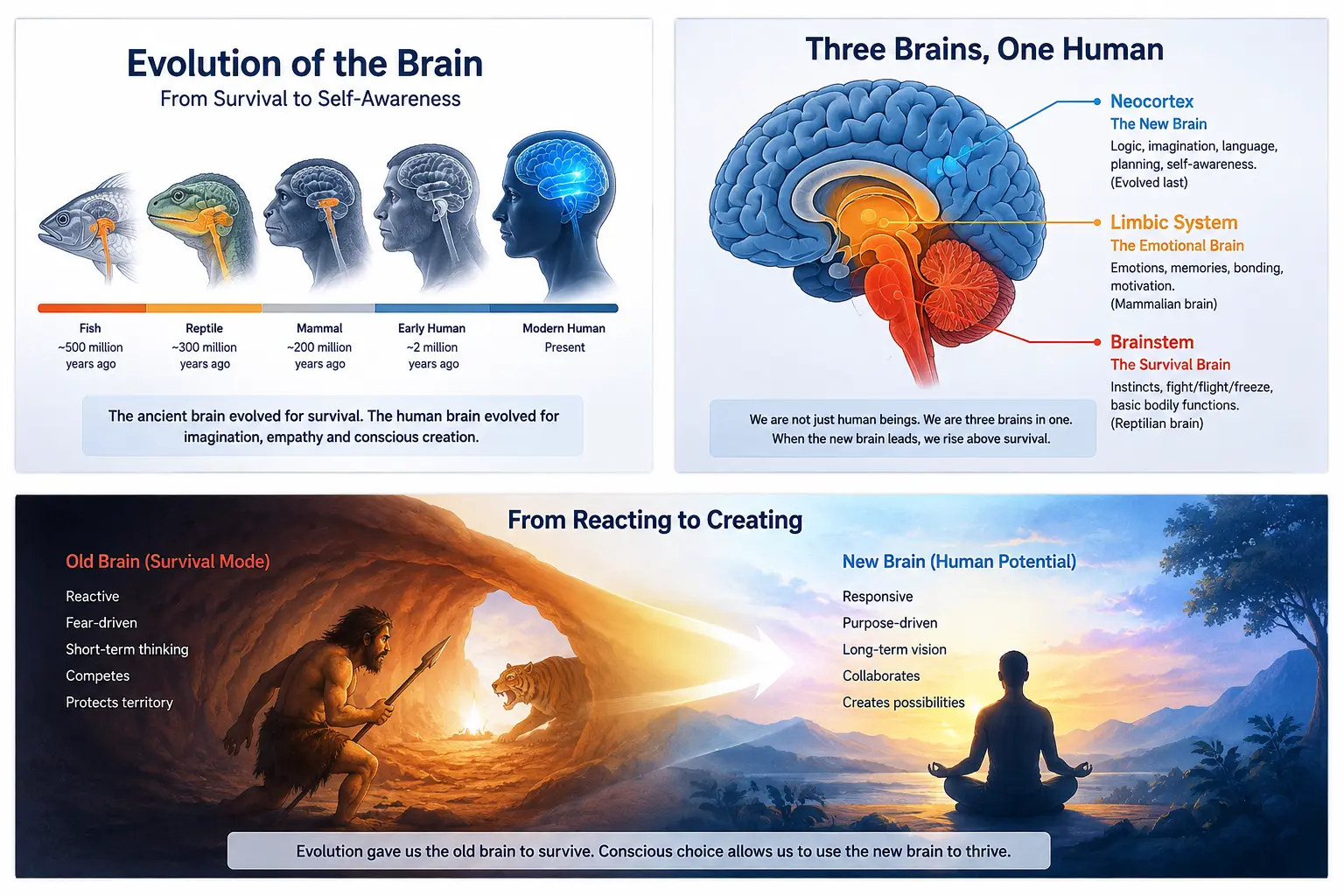
Every human being carries the full machinery of a human brain. Very few of us actually use it.
Most of the day, most of us are run by circuits that are far older than our species — circuits designed for two purposes only: stay alive, and pass on your genes. Anger, fear, hunger, sexual drive, territory, status, the hunt for the next reward. These are not defects. They kept our ancestors alive for millions of years. The problem is that we are still living by them in a world they were never designed for, while the part of the brain that makes us human sits largely unused.
First, a correction worth making
You will often hear that we have "three brains" stacked one on top of the other — a reptilian brain, then an emotional mammal brain, then a rational human brain. That model came from Paul MacLean in the 1960s, and as an anatomical and evolutionary claim it has been rejected by modern neuroscience. All vertebrates share the same basic brain plan; nothing was simply bolted on top of something older, and no region works in isolation.
But the functional observation behind it is real and well documented. The brain has fast, automatic, survival-first circuits, and it has slow, effortful, goal-directed control circuits — and the second can be overpowered by the first. That is the story worth telling. Not three brains. One brain, running at two very different speeds.
The fast road: how a threat becomes a reaction before you know it
Sensory information arriving at the thalamus takes two paths at once.
The short path runs straight to the amygdala — crude, fast, and ready to act on a rough sketch. This is why you jump back from a rope on the floor before you have decided it is a rope. The amygdala signals the hypothalamus and the brainstem: adrenaline, cortisol, heart rate up, breathing rapid and shallow, muscles tense, gut shut down, pupils wide.
The long path runs from thalamus to sensory cortex to the prefrontal cortex, where the situation is actually evaluated — rope, not snake — and a signal is sent back down to switch the alarm off. This road is far more accurate. It is also slower. By the time it arrives, your body has already reacted.
Around this sit the other survival systems: the hypothalamus governing hunger, thirst, temperature, and sexual drive; the ventral tegmental area and nucleus accumbens releasing dopamine not when you get a reward but when you anticipate one; the dorsal striatum converting anything repeated into an automatic habit that no longer needs a decision; the hippocampus tagging memories with the emotion attached; the insula reading the state of the body and turning it into a feeling.
The slow road: what actually makes us human
The prefrontal cortex — particularly the ventromedial and dorsolateral regions and the anterior cingulate — is the part that developed most dramatically in our species. Its work is unglamorous and it is everything:
- It holds a goal in mind when nothing in the environment is reminding you of it.
- It sends inhibitory signals through the intercalated cells of the amygdala to quieten a fear response that is no longer useful.
- It compares a reward available now against a larger reward available later — and can choose later.
- It runs a simulation: if I say this, what happens next month?
- It lets you take another person's point of view.
- It permits an action to be judged as right or wrong, not merely as pleasant or unpleasant.
An animal cannot postpone a reward for twenty years to educate a child. It cannot forgive. It cannot sit with a book for three hours. It cannot decide to be kind to someone who cannot benefit it. The frontal lobe is where the human being actually lives. The rest of the brain we share with the animal kingdom.
So why does the old system keep winning?
Because stress switches the control off — and this is now well demonstrated in the laboratory. Under stress, high levels of noradrenaline and dopamine flood the prefrontal cortex and rapidly weaken its synaptic connections, reducing exactly the sustained firing that goal-directed thought depends on. In the same moment, the same chemistry strengthens amygdala responses and striatal habits.
Prolonged, uncontrollable stress goes further: it causes loss of dendrites and spines in the prefrontal cortex, while dendrites in the amygdala extend and branch. The structure itself shifts. Control shrinks; alarm grows.
Note the crucial detail — this needs only mild stress, if the person feels threatened or out of control. An unpaid EMI. A message left on read. A colleague promoted ahead of you. A comment section. The body cannot tell the difference between a predator and a notification; it makes the same chemistry either way.
And in modern life, that state never switches off. What was designed as an emergency response has become the resting condition of a whole population.
The urgent defeats the important — and we call it procrastination
Every plan to build the frontal lobe — reading, learning an instrument, exercise, silence, prayer, a difficult but necessary conversation — belongs to the category of important but not urgent. Every one of these requires prefrontal effort and pays out slowly.
Every alarm — the phone, the argument, the deadline, the notification — is urgent but rarely important. It costs no effort at all. It pulls attention automatically, because that is precisely what the amygdala and the dopamine system were built to do.
So the important gets postponed indefinitely. The music practice, the walk, the book, the honest conversation with your spouse. This is not weakness of character. It is a brain in which the alarm system has been left permanently switched on, so that the slower system never gets a quiet enough room to work in. The person is not lazy. Their prefrontal cortex is being outbid every few minutes.
Social media: the animal brain at industrial scale
Evolution has not stopped. But for the first time, an enormous industry now exists whose entire commercial purpose is to keep the old circuits activated.
The design is precise. An unpredictable reward on every scroll — the same variable schedule that makes gambling compulsive. Social approval and social threat, the two things a group-living primate is built to monitor above all else. Outrage, which travels faster than anything else because threat detection is the amygdala's first job. And short-form video, in which the reward arrives every few seconds, so that no sustained attention is ever required or trained.
The evidence is accumulating and it is consistent. Heavy short-form video use is associated with poorer sustained attention and, most strongly, with poorer inhibitory control. Neuroimaging shows reduced activation in the very regions responsible for top-down control during this kind of engagement, and habitual users show a steeper preference for immediate over delayed reward.
Understand what that means physically. Two hours of scrolling is not neutral rest. It is two hours of training the fast system and starving the slow one. Then the person opens a book and cannot hold a page. The book is not the problem.
Then the body sends its bill
A brain locked in survival mode produces a body locked in survival mode, and after some years that body has a diagnosis.
Sitting. A stressed, scrolling life is a still life. Prolonged sedentary behaviour is now known to produce whole-body insulin resistance, vascular dysfunction, loss of muscle mass and strength, a shift of muscle fibre away from oxidative type, and increased total and visceral fat. Visceral fat is not inert storage — it is an active inflammatory organ, releasing cytokines that further impair insulin signalling. Insulin resistance in turn drives type 2 diabetes, dyslipidaemia, hypertension and atherosclerosis. The chain is complete: a mind that cannot sit still ends in a body that never moves at all.
Breathing. Chronic sympathetic arousal produces a rapid, shallow, upper-chest breathing pattern. (This does not starve healthy lungs of oxygen — that is a common misconception — but it does something else.) It shifts the autonomic balance towards sympathetic dominance and reduces baroreflex sensitivity, and hypertensive patients characteristically show this over-breathing pattern. Reverse it deliberately — slow breathing at around six breaths a minute — and baroreflex sensitivity rises, vagal tone rises, and blood pressure falls, measurably, within minutes. The breath is one of the few switches into the autonomic system that we can operate voluntarily. It is not mysticism. It is a reflex arc, and it has been measured.
Posture and spine. Low mood and defeat produce a stooped, collapsed posture; that is universal, and observable in any OPD. Held for years, a forward head and rounded thoracic spine change the mechanics of the cervical and lumbar spine, increase load on the discs and facet joints, and shorten and weaken the muscles that were supposed to be sharing that load. Add inactivity, and the joints lose the movement that cartilage and synovium depend on. Add visceral fat, and you add both mechanical load and a systemic inflammatory background to joints that are already struggling. Neck pain and low back pain, in a very large number of the patients I see, are the mechanical signature of a life lived stressed and still.
What art, music, love and spirituality are actually for
Here is the argument I want to leave you with.
Every civilisation independently invented the same set of things: music, dance, poetry, story, sculpture, ritual, prayer, meditation, ethical codes, kindness to strangers. We treat them as decoration — the optional part of life, once the serious business is done.
They are not decoration. They are the training equipment of the frontal lobe, developed by trial and error over thousands of years, long before anyone could image a brain.
- Music demands sustained attention with no immediate survival reward, and engages large-scale networks including right-hemisphere parietal and temporal regions for melody, spatial pitch and rhythm — networks the daily grind never touches.
- Literature forces you to hold a long structure in working memory and to simulate another person's mind — the exact operation the prefrontal cortex exists to perform.
- Dance couples movement, rhythm, and the presence of others, and refuses to let the body stay still.
- Meditation and prayer are, in plain terms, deliberate practice at noticing an impulse without obeying it — which is the definition of prefrontal control.
- Kindness and forgiveness are frontal-lobe acts by definition. They require you to override a legitimate survival-level grievance in favour of a longer, larger good. No animal can do it. That is precisely why we admire it.
Seen this way, the whole of culture becomes a single project: a species building tools to overrule its own instincts. Every temple, every raga, every epic, every code of ethics is an instrument for the same purpose.
Evolution has not stopped — but its direction is now our choice
The brain remains plastic throughout life. Whatever is repeated is strengthened; whatever is neglected is pruned. This is not a metaphor; it is the operating principle of the nervous system.
Which means the question is no longer what we inherited. It is what we are practising.
A person who spends four hours a day in variable-reward scrolling and reacting is not standing still. They are actively training the animal brain and letting the human one atrophy. A person who reads, walks, plays, prays, breathes slowly, and holds their tongue in an argument is training the opposite. Both are performing an experiment on their own nervous system. Only one of them knows it.
Where to begin
Nothing here requires a hospital. It requires knowing which system you are feeding.
- Start with the breath, because it is the only autonomic switch under voluntary control. Five minutes, roughly six breaths a minute, exhalation longer than inhalation. Do it before the day begins, not after it has defeated you.
- Break the sitting, not just the week. Standing and walking for a few minutes every half hour affects glucose handling more than a single session at the gym after eight hours in a chair.
- Protect the first hour of the day from the phone. Whatever gets the prefrontal cortex first, gets it at full strength.
- Give the frontal lobe one long task a day — a book, an instrument, a language, a piece of real work with no notifications in the room. Thirty unbroken minutes is worth more than three broken hours.
- Move the spine daily. Neck, thoracic and lumbar range of movement, and the postural muscles that hold you upright. Cartilage has no blood supply of its own; movement is how it is fed.
- Practise one deliberate override. One argument you do not enter. One craving you observe and do not act on. Each one is a repetition, and repetitions are how circuits are built.
Anger, hunger, fear, lust, status, and the endless scroll are not sins. They are the oldest and most reliable machinery you own, and they will never be removed. But you were given something else as well, and it has to be used or it fades.
To be born human is an accident of biology. To become human is a daily decision — and the brain keeps the score.
This article is for general education and does not replace individual medical advice. If you have persistent headache, neck or back pain, numbness, weakness, giddiness, or uncontrolled blood pressure or blood sugar, please get examined.
🩺 Book a Consultation🩺 परामर्श बुक करें
Consult Dr P K Jha — OPD at Gaur City 1, Greater Noida, or online. डॉ पी के झा से मिलें — गौर सिटी 1 OPD या ऑनलाइन।
